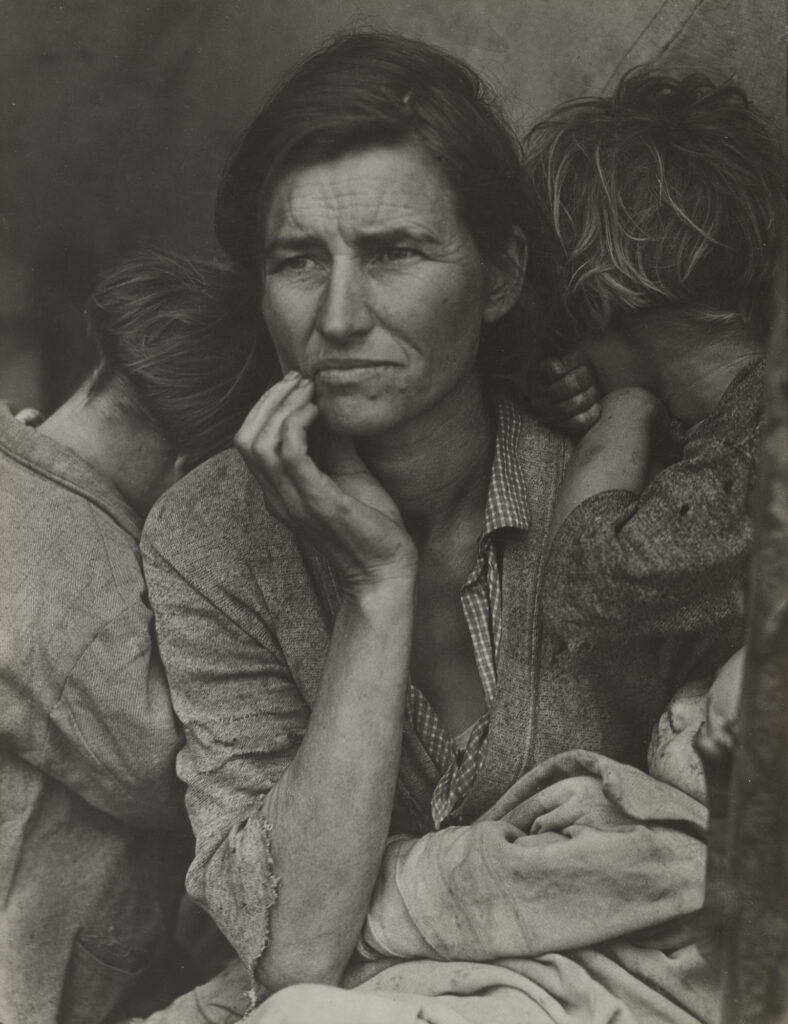
Dorothea Lange’s 1936 photograph Migrant Mother is one of the most iconic images of the Great Depression. Taken while Lange was employed by the U.S. Farm Security Administration (FSA), the photograph captures the hardship of migrant farmworkers and quickly became a symbol of national struggle and resilience. Because the image appears everywhere from textbooks to museum websites to digital history projects, it raises an important question. It makes people question whether the photograph is freely available for public use or if the copyright determines how it can be shared. Understanding the legal status of widely reproduced historical images helps reveal how access to the past is shaped not only by archives and institutions but by copyright law itself.
Migrant Mother was created in 1936 while Lange was working as a federal government employee. Under U.S. copyright law (17 U.S.C. §105), works created by federal employees as part of their official duties automatically enter the public domain. This means the original negative, held by the Library of Congress, can be used, shared, or adapted by anyone without permission or fees.
However, complications arise in the digital realm. Although the photograph itself is public domain, museums and archives sometimes claim rights over digitized versions. High-resolution scans, restored images, or versions with museum watermarks may come with their own terms of use. These claims do not change the underlying legal status of the photograph, but they can restrict how easily people access or reuse institutional copies. For digital history work, the safest approach is using sources like the Library of Congress, which offers unrestricted public-domain versions.
The issues raised by Migrant Mother connect closely to themes in several course readings. “The Amen Break” illustrates how copyright can both inspire and constrain creativity. A six-second drum sample became foundational to modern music, yet remained copyright-protected, limiting artists’ freedom to use it. The contrast is striking: Migrant Mother belongs to the public domain, allowing educators and creators to use it without fear. The reading shows how access or lack of access to cultural material directly shapes creative possibilities.
Cory Doctorow’s article on Mickey Mouse and the public domain also echoes these concerns. Doctorow argues that corporate lobbying repeatedly extended copyright to keep iconic cultural works locked away from the public. Lange’s photograph avoided this fate only because it was a government work. If Migrant Mother had been privately owned, it might still be under copyright today, severely restricting its use in classrooms, archives, and digital projects.
Copyright status has major consequences for historians, educators, and digital archives. Public-domain images like Migrant Mother enable open access, they can appear on Wikipedia, in documentaries, in museum exhibits, and in student projects without legal barriers. In contrast, copyrighted historical materials often require fees or permissions, limiting who can tell certain stories. Ethical questions also emerge: if a work legally belongs to the public, should institutions be able to place restrictions on their digitized copies? Some argue that historical materials should be universally accessible, while others note that digitization requires funding and labor. Migrant Mother demonstrates how public-domain status supports a more open and democratic historical record.
In the end, Migrant Mother is firmly in the public domain, yet its digital circulation reveals how institutions can shape access nonetheless. For future historians, this case highlights why copyright literacy matters. Literacy affects what stories can be told and who gets to tell them. If we want broader access to historical materials, expanding and protecting the public domain may be essential.